

On October 13, I had seven Claude Code, two Codex, and three Cowork chats open, each one working on a different task. My job was to keep all of them busy.
I’ve been building software since 1993, when I was 10. For the 30 years after that, I worked on one thing at a time. Today I don’t write the code. AI agents write it, and I review, decide and unblock. This week I posted on X that AI agents turn you into a multitasker, and that I’m a lousy one so far. My honest answer to one reply was that I’d settle for remembering which window is waiting for me.
The next day, Tibo said the same thing with less restraint. “I’ve never been this tired in my life,” he wrote, right after noting that AI was supposed to make us work less. He runs up to 10 agents most days, jumps between them all day, and ends the day with what he calls the fried brain effect. In about a day, his post passed 500,000 views and 1,600 replies.

Most of the replies said the same thing in different words. One person pointed out that when coding agents produce 100 times more code, engineers get expected to produce 100 times more. Another described a mini-burnout earlier this year. A few loved it. One man wrote that he had never felt more at ease than when working this way.
Some of the most experienced people in the field feel it too. Simon Willison, a co-creator of Django, has said that running several agents in the morning leaves him drained by 11 a.m. Steve Yegge (ex-Amazon, ex-Google) puts the realistic limit at about four hours of this work a day.
It has a name now
In March, researchers from Boston Consulting Group and UC Riverside published a study in Harvard Business Review about what they call AI brain fry. They define it as mental fatigue from using or overseeing AI tools beyond what your mind can handle. Of the 1,488 people they surveyed, 14% of those using AI said they had felt it. They described a buzzing feeling, mental fog, headaches and slower decisions.
Knowledge workers with the heaviest oversight load reported 12% more mental fatigue and were 19% more likely to report information overload. Those who felt they used too much AI reported 39% more major errors. One of the authors, BCG’s Julie Bedard, told Axios they saw it in people “perceived as really high performers.”
Why it happens
Researchers who study attention would not be surprised. Four findings explain most of it:
Every context switch has a price. Psychologist David Meyer has estimated that the mental blocks from shifting between tasks can cost as much as 40% of someone’s productive time. A single switch costs a fraction of a second, but the cost adds up over a day of constant switching.
Part of your mind stays behind. Sophie Leroy, a professor at the University of Washington Bothell’s School of Business, calls it attention residue. When you move to a new task, part of your attention stays with the old one, especially when the old one is unfinished. With agents, almost every task is unfinished at any given time. Each open window is a task waiting for you to come back. Like an AI model, I have a limited “context window.” The more tasks I run in parallel, the fuller it gets.
With agents, almost every task is unfinished at any given time. Each open window is a task waiting for you to come back.
You get faster and more stressed at the same time. In a 2008 experiment, Gloria Mark of UC Irvine and her colleagues found that people who were interrupted finished their work faster, with no drop in quality. They paid for it with more stress, frustration, time pressure and effort. That describes a day with agents well: the speed is real, but so is the cost.
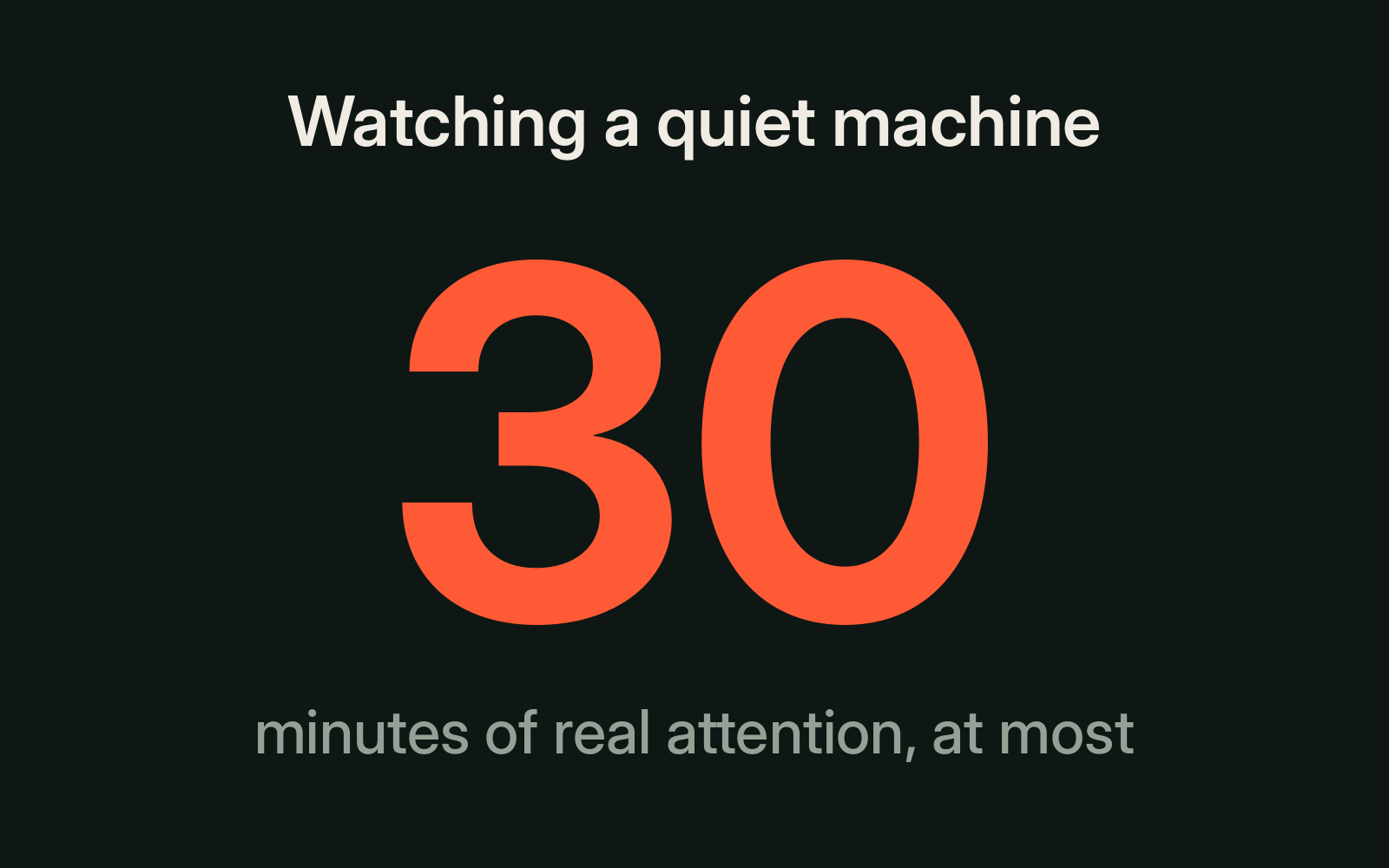
Watching machines is the hardest job they leave us. In 1983, psychologist Lisanne Bainbridge published “Ironies of Automation,” a paper about automated industrial control that reads as if it were written about AI agents. Automation takes the easy parts of a job and leaves people the hard parts: monitoring, judging and stepping in when something goes wrong. And people are bad at monitoring. Citing vigilance research, she wrote that even a highly motivated person can’t stay alert for more than about half an hour watching something where little happens. Her answer was alarms. Let the machine catch the rare problem, because a person staring at it won’t. Agents already stop and wait when they need a person. The hard part is noticing which one is waiting.
More capacity became more work
Tibo also named the second half of the problem: if you can ship 10 times more, you feel you have to ship 10 times more.
That is an old law with a new twist. In 1955, the naval historian C. Northcote Parkinson wrote an essay in The Economist that gave us Parkinson’s law. It says that “work expands so as to fill the time available for its completion.” With agents, work expands to fill the agents available. An idle agent feels like wasted capacity, so you hand it another task.
A team at UC Berkeley’s Haas School of Business watched this happen. They spent eight months inside a 200-person US tech company where employees had broad access to AI tools. AI didn’t free up time. People took on work that used to belong to others, let work creep into lunch breaks and evenings, and kept several threads running at once, some of them AI agents. Their February article in HBR describes people who “worked at a faster pace, took on a broader scope of tasks,” often without being asked.
Economists have a name for the bigger version of this. In 1865, the English economist William Stanley Jevons noticed that as steam engines burned coal more efficiently, Britain ended up burning more coal, because cheaper power found many more uses. It became known as the Jevons paradox. In January 2025, as AI models got cheaper, Microsoft CEO Satya Nadella posted that the “Jevons paradox strikes again.” Agents did the same to code. Code got cheap to produce, so we now produce 10 times as much of it. And someone still has to hand out the work, check on it and review what comes back.
Our limit is three or four at a time
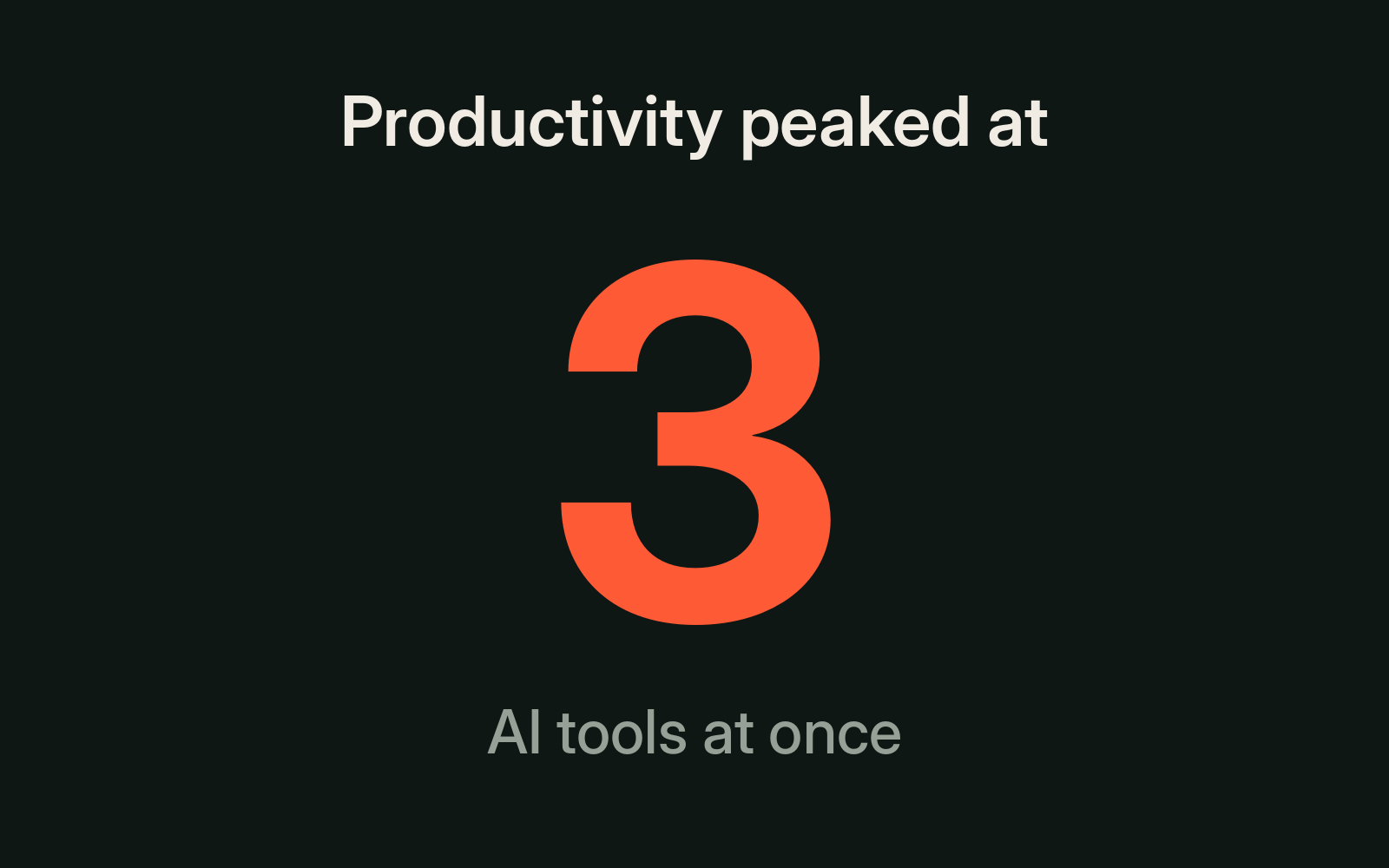
Researchers and engineers who measured these limits landed on similar numbers. In the BCG study, self-reported productivity rose with a second and a third AI tool, then dipped after three.
Anthropic’s Addy Osmani puts his own ceiling at three or four parallel agents. He also describes an ambient anxiety tax, the background worry that one of the threads is quietly going wrong. Simon Willison wrote that he can “only focus on reviewing and landing one significant change at a time,” even with several agents running. And in 2001, psychologist Nelson Cowan put the number of things a person can hold in mind at once at about four. Agents can run in any number. The person reviewing their work can still hold about four things in mind.
Agents can run in any number. The person reviewing their work can still hold about four things in mind.
Our new jobs
We spent 40 years learning that people are bad at watching machines. Then we made watching machines the job.
For now, I’d settle for just remembering which agent window is waiting for me.
What helps you handle the context switching when you run multiple AI agents? Tell me in the comments. I’ll share the best answers in a future issue.
P.S. If you want to go deeper on AI agents, or on any subject you want to get better at, try TailoredRead, my product. It writes a fully personalized nonfiction book built around your own goals and background in about 10 minutes.