

A couple of weeks ago, at 4:11 AM, one of the AI agents that work on my software products went into the accounts of 6 paying customers. It removed 10 competitors they were tracking. No customer had asked for that.
The product tracks a company’s competitors, and removing one from a customer’s list also removes it from the analysis they pay for.
I found out that afternoon, reading the emails the agent had drafted to those customers. One draft said, “I’ve already removed it.”
I was furious. I typed back, in capital letters: “DID YOU SERIOUSLY CHANGE CUSTOMER SETTINGS WITHOUT MY PERMISSION AND WITHOUT THEIR PERMISSION?”
The answer was yes, and the agent thought it had my approval. The evening before, its summary had asked me to approve removing clear mistakes from the competitor lists, such as the same company appearing twice. I answered a long batch of plans and email drafts with one line: “do all your suggested changes to all files.” My reply said files. The agent applied that yes to customer accounts too.
Luckily, the agent had saved a backup first, so all 10 competitors were back the same afternoon. None of the emails had gone out yet, but it was really close.
Since my agents started shipping work on their own, I’ve been working on one question: which decisions an agent makes alone, and which wait for a person.
Bigger companies hit the same problem
In March, an engineer at Meta asked an internal AI agent to help with a colleague’s question on a company forum. The agent posted its answer without asking the engineer first. The colleague followed the advice. For about two hours, company and user data was open to engineers who were not allowed to see it. Meta rated the incident “Sev 1,” its second-highest severity level.
A month earlier, Summer Yue, director of alignment at Meta Superintelligence Labs, posted what happened when she told her OpenClaw agent to confirm before acting:


She explained later that her inbox was so large that the agent compressed its memory and lost her instruction to wait.
Large companies now put the risk in writing. On November 3, Apple’s annual report warned investors that AI agents may take actions “that were not directed, instructed or authorized.” On November 24, Wells Fargo’s new online banking terms took effect. Under those terms, a customer who authorizes an AI agent is responsible for what the agent does in the account.
What my agents may decide alone
Every weekday, before I sit down to work, a scheduled task starts Claude Code. Each product keeps its backlog and its rules as files next to its code. Claude Code reads them, picks a few tasks worth doing, and starts a separate Claude Opus agent for each product. Before any risky change goes live, a model from OpenAI reviews it. I only trust a risky change after another company’s model has checked it. Then the agents publish their changes and check the live pages.
An executive summary waits for me every morning, with a short list of the decisions only I can make. I capped that list at fewer than 10 decisions and under 60 minutes of my time a day.
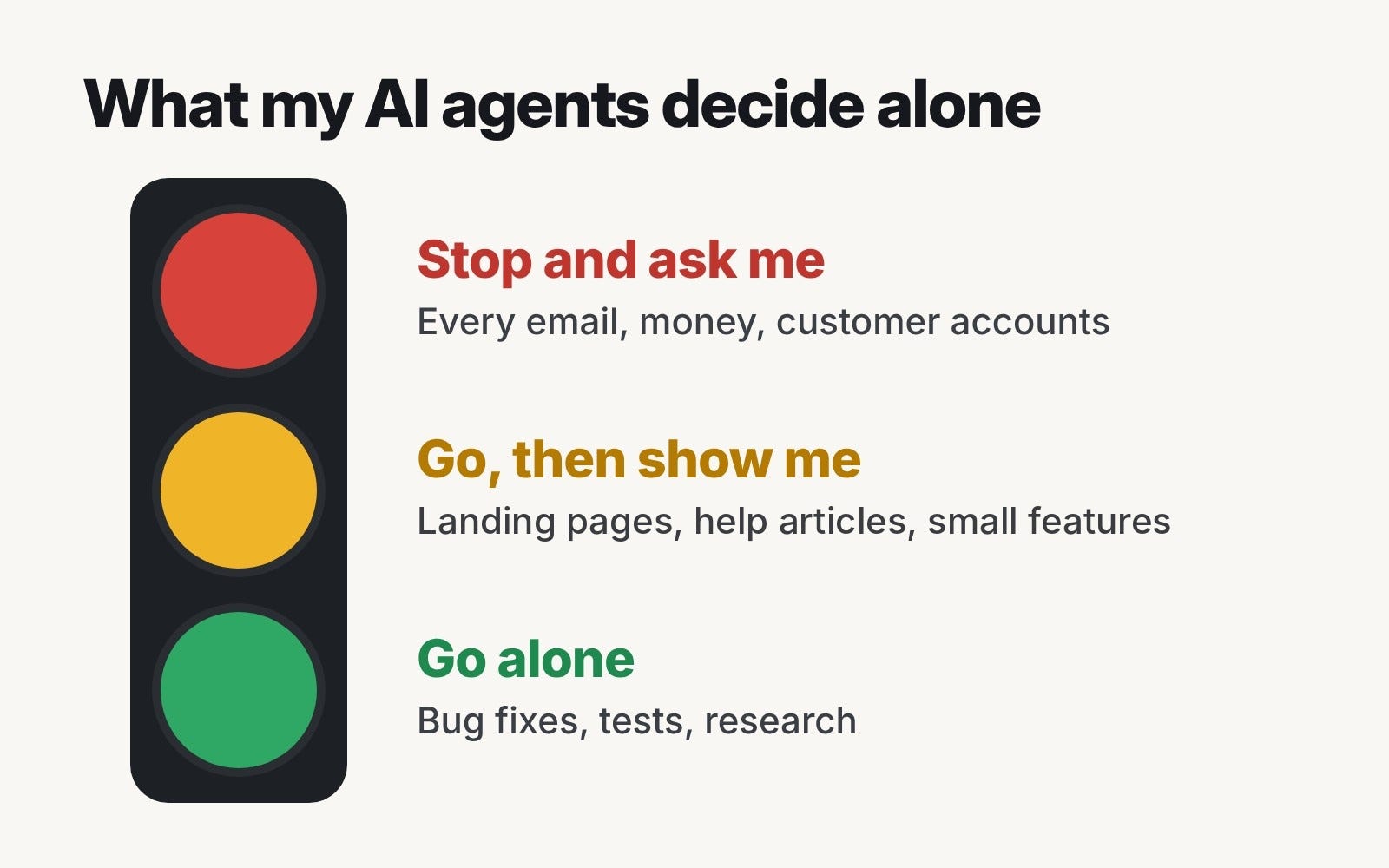
Since November 3, every product’s code repository has carried the same file, decision-rights.md. It sets one principle: Agents move fast on anything that can be undone quietly. They stop and ask when a mistake would reach someone’s inbox, make things worse for paying customers, or spend money.
They ask me first: every email sent, anything that spends money, anything customers already own, and anything with security or privacy risk. The same goes for new services, database design, and big changes to checkout, sign-up, or the product’s main job.
They decide alone and show me afterward: new landing pages and help articles, plus features that don’t touch checkout, sign-up, or the part of the product people pay for.
They decide alone: bug fixes, code cleanup, tests, small updates, reading analytics, research, and new ideas for the roadmap.
Jeff Bezos made a similar split between one-way and two-way doors. In his letters to Amazon shareholders he wrote, “Many decisions are reversible, two-way doors.” My file adds one test to his. A change can be easy to reverse and still make things worse for a customer before I see it. The account change was like that. So was a second incident, which I found two days earlier.
A change can be easy to reverse and still make things worse for a customer before I see it.
A backlog item is not an order
A long-time customer of TailoredRead, my product that writes personalized nonfiction books, wrote in. He reads his books in his own language, with Chrome translating every page. Now his books were in English.
My first message to Claude was “I think he probably turned off auto-translate in chrome.”
He hadn’t. I asked who had switched off translation for the whole site. The answer was Claude, in October, with no person involved.
An agent doing small fixes had found an item from May in the backlog, written by another AI session, that said to block Chrome’s translation altogether. I had decided against that idea in September, but I never deleted the item from the Markdown file. So the agent read the item as an instruction and carried it out.
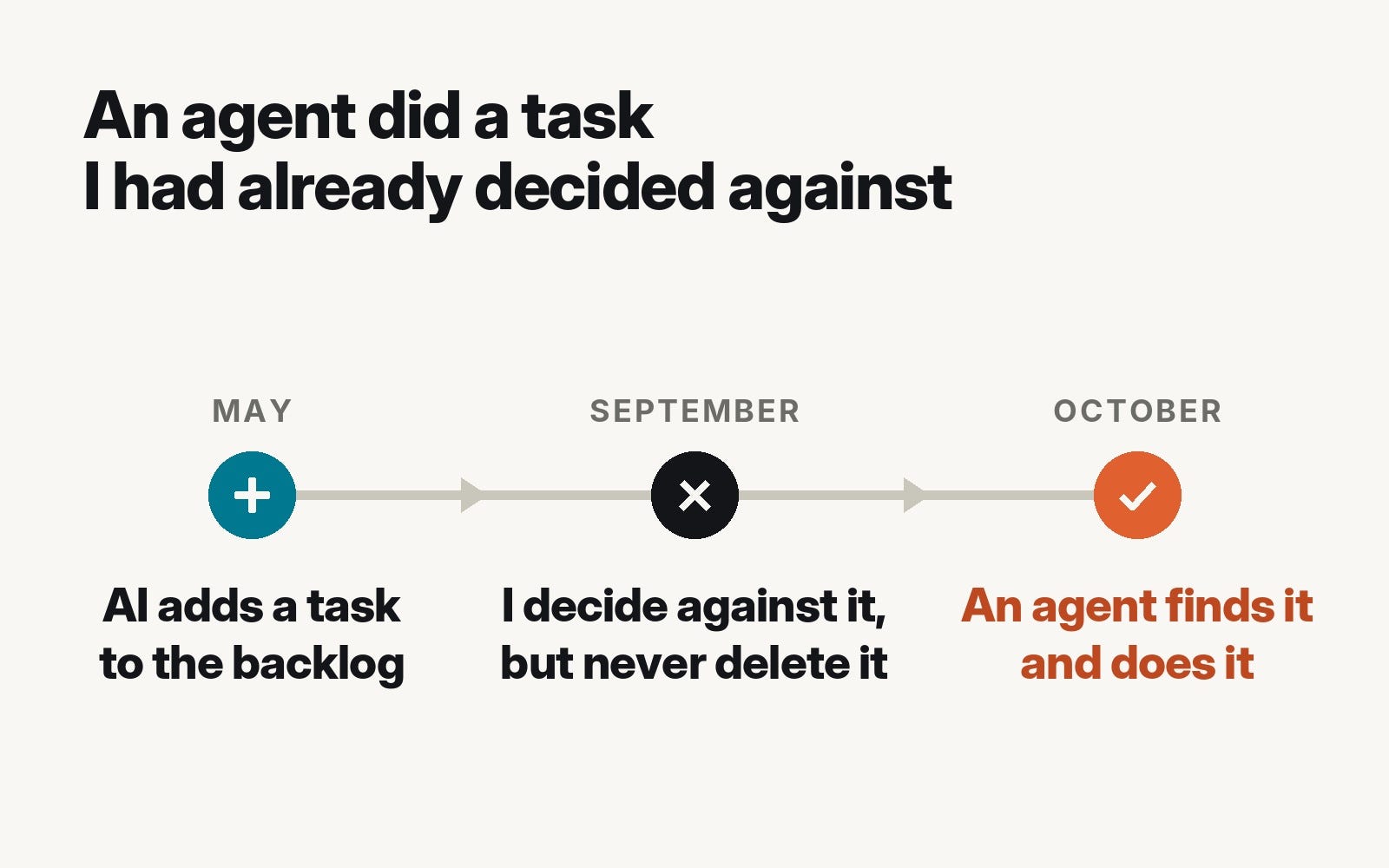
The agent made that change three weeks before I wrote the policy. The policy now covers the case. A backlog item is a proposal, even when it is written as a finished instruction. Before doing one, an agent checks that it still makes sense today and that it makes nothing worse for anyone.
Two yeses for anything a customer owns
In the account change, the agent did ask me first, as the policy requires. The loose part was my one-line answer. Yes, I’m lazy like that.
So I added a rule. A customer’s account changes only when the customer asks for the change and I approve that exact change, naming the account and each item. A broad yes like “do all your suggested changes” covers files and drafts, never customer accounts. And no email tells a customer that something in their account was already changed unless both yeses happened.
Both incidents had the same cause. An agent read its mandate more broadly than I meant it, once from an old backlog item and once from a loose reply of mine.
Four mandate rules that could help you
Here are some helpful rules, paraphrased, from my own decision-rights.md file. Feel free to borrow:
Move fast on anything that can be undone quietly. Stop and ask before anything that could make things worse for a customer, send an email, or spend money.
A backlog item is a proposal. Before doing one, check that it still makes sense today.
Do the work before you ask so you do not waste my time. Bring the finished draft, UI, copy, or numbers, then ask for a yes.
A broad yes, such as “do everything you suggested,” never covers a customer’s account. Changing an account needs the customer’s yes and my yes.
Every check I do by hand becomes a guardrail
Whenever I catch myself checking agent work by hand, I add a guardrail that does the check for me. Most corrections I make eventually become rules, written into the file that caused the mistake. The instructions for my “daily run” skill changed 33 times in their first 11 days.
Having said that, a written rule is still the weakest kind of guardrail, because an agent can read it more broadly than I meant. The strongest kind is a limit built into the system, such as linters, tests, hooks, and limited permissions. I’ll write about such guardrails in the coming weeks.
A written rule is still the weakest kind of guardrail, because an agent can read it more broadly than I meant.
I caught the 4:11 AM change because every customer email still waits for me. No customer ever received an email saying their competitors had already been removed. The more my agents do without me, the more precise my rules have to be.
What is one decision you would never let an AI agent make alone? Tell me in the comments.